2026年2月15日

To Fly Free in Space
Image Credit: NASA, STS-41B
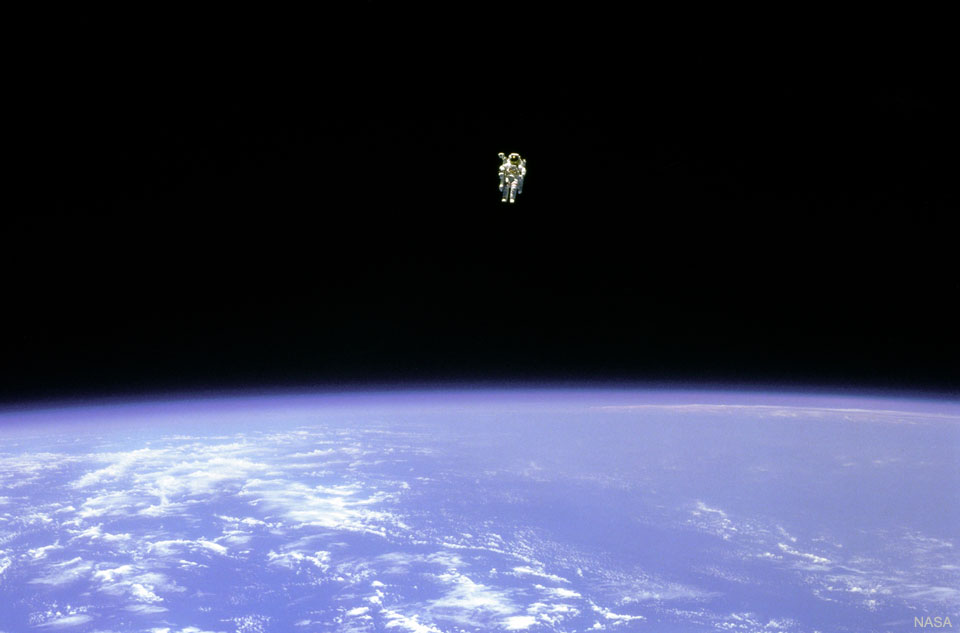
Explanation: What would it be like to fly free in space? About 100 meters from the cargo bay of a space shuttle, Bruce McCandless II was living the dream — floating farther out than anyone had ever been before. Guided by a Manned Maneuvering Unit (MMU), astronaut McCandless, pictured, was floating free in space. During Space Shuttle mission 41-B in 1984, McCandless and fellow NASA astronaut Robert Stewart were the first to experience such an “untethered space walk“. The MMU worked by shooting jets of nitrogen and was used to help deploy and retrieve satellites. With a mass over 140 kilograms, an MMU is heavy on Earth, but, like everything, is weightless when drifting in orbit. The MMU was later replaced with the SAFER backpack propulsion unit.
Tomorrow’s picture: unexplained shocks
说明: 在太空中自由翱翔会是什么感觉?距离航天飞机的货舱约100公尺处,布鲁斯·麦坎德利斯二世正把梦想化为现实—他在当时创下人类飘离载具最远的纪录,于真空中无拘无束地在太空中自由漂浮(见照片)。他的行动由载人机动装置(MMU)引导。在1984年的航天飞机任务41-B期间,麦坎德利斯与搭档、NASA宇航员 罗伯特·斯图尔特,首次体验了这种「无系留」的太空行走。MMU以喷射氮气产生反作用力,可用于协助部署与回收卫星等任务。虽然其质量超过140公斤,MMU在地球上相当笨重,但在轨道上与万物一样处于失重环境中。后来,MMU被简易舱外活动救援辅助系统SAFER所取代。
明日的图片: unexplained shocks