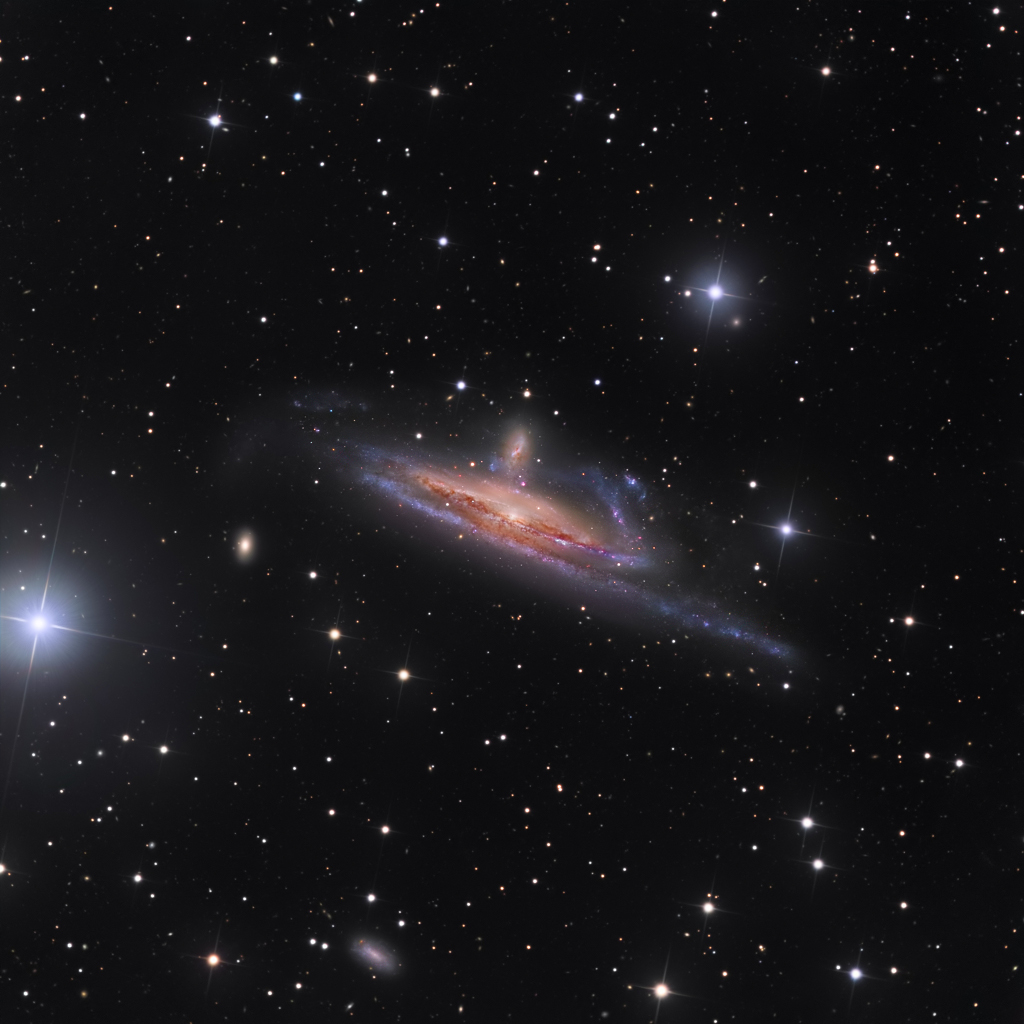
星系

NASA·每日一图

哈勃望远镜拍摄了一个食人族星系

This remarkable spiral galaxy, known as NGC 4651, may look serene and peaceful as it swirls in the vast, silent emptiness of space, but don’t be fooled — it keeps a violent secret. It is believed that this galaxy consumed another smaller galaxy to become the large and beautiful spiral that we observ […]

NASA·每日一图

哈勃太空望远镜拍摄到一个单臂星系

NGC 4618 was discovered on April 9, 1787, by the German-British astronomer William Herschel, who also discovered Uranus in 1781. Only a year before discovering NGC 4618, Herschel theorized that the “foggy” objects astronomers were seeing in the night sky were likely to be large star clusters located

NASA·每日一图

观看我们的银河系中心

The central region of our galaxy, the Milky Way, contains an exotic collection of objects, including a supermassive black hole weighing about 4 million times the mass of the Sun (called Sagittarius A*), clouds of gas at temperatures of millions of degrees, neutron stars and white dwarf stars tearing

资讯

跨星系的类星体海啸

一个天文学家小组利用美国国家航空航天局(NASA)的哈勃太空望远镜(Hubble Space Telescope)的独特功能,发现了宇宙中有史以来最强劲的能量外流。它们从类星体发出,像海啸一样横扫星际空间,对类星体所在的星系造成严重破坏。 类星体是极遥远的天体,释放出异常巨大的能量。类星体中包含着由入射物质推动的超大质量黑洞,这些物质的亮度是由几千亿颗恒星组成的主星系的1000倍。 当黑洞吞噬物质时,热气体将其包围并发出强烈的辐射,从而形成类星体。由黑洞附近的炽热辐射压力驱动的风将物质推离银河系的中心。这些流出物加速到惊人的速度,其速度达到光速的百分之几。 “没有其他现象会携带更多的机械能。在

NASA·每日一图

哈勃太空望远镜监视银河交通堵塞

The barred spiral galaxy NGC 3887, seen here as viewed by the Wide Field Camera 3 aboard the NASA/ESA Hubble Space Telescope, lies over 60 million light-years away from us in the southern constellation of Crater (the Cup). It was discovered on Dec. 31, 1785, by astronomer William Herschel. Its orien

资讯

破纪录的黑洞爆炸被发现

宇宙中所见最大爆炸的证据来自钱德拉和XMM-牛顿卫星的X射线数据,以及默奇森宽场阵列射电望远镜和巨米波射电望远镜,如图所示。这次喷发是由位于星团中心星系的一个黑洞引起的,它喷发出了喷流,并在周围的热气体中形成了一个大洞。研究人员估计这次爆炸释放的能量是之前记录保持者的5倍,是典型星系团的数十万倍。 来源:X-ray: Chandra: NASA/CXC/NRL/S. Giacintucci, et al., XMM-Newton: ESA/XMM-Newton; Radio: NCRA/TIFR/GMRT; Infrared: 2MASS/UMass/IPAC-Caltech/NASA/NSF

天文·每日一图

UGC 12591:已知自旋最快的星系

2020 February 19 UGC 12591: The Fastest Rotating Galaxy Known Image Credit: NASA, ESA, Hubble; Processing & Copyright: Leo Shatz Explanation: Why does this galaxy spin so fast? To start, even identifying which type of galaxy UGC 12591 is difficult — featured on the lower left, it has dark

NASA·每日一图

钱德拉发现一个正在形成的巨型星系团

Astronomers using data from NASA’s Chandra X-ray Observatory and other telescopes have put together a detailed map of a rare collision between four galaxy clusters. Eventually all four clusters — each with a mass of at least several hundred trillion times that of the Sun — will merge to form o

NASA·每日一图

哈勃太空望远镜从著名的星表中观察星系

This bright, somewhat blob-like object — seen in this image taken by the NASA/ESA Hubble Space Telescope — is a galaxy named NGC 1803. It is about 200 million light-years away, in the southern constellation of Pictor (the Painter’s Easel). NGC 1803 was discovered in 1834 by astronomer John Herschel.

天文·每日一图

波江座的星系

2020 January 8 Galaxies in the River Image Credit & Copyright: Star Shadows Remote Observatory, PROMPT, CTIO Explanation: Large galaxies grow by eating small ones. Even our own galaxy engages in a sort of galactic cannibalism, absorbing small galaxies that are too close and are captured by the M

滚动至顶部